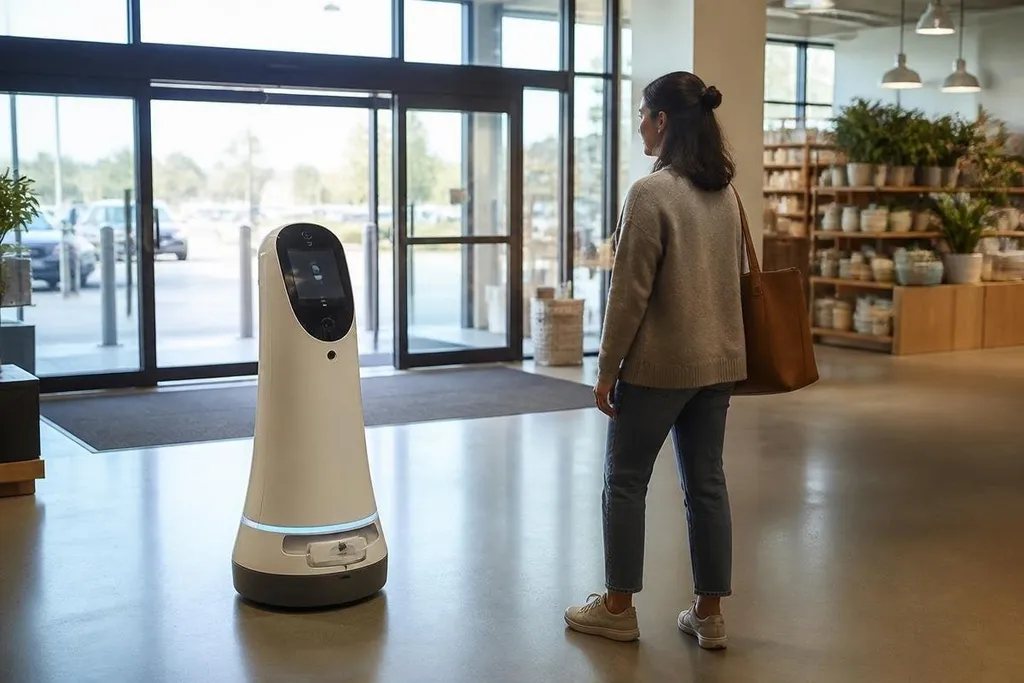
A robot at a shop entrance can welcome customers, point to a department, and call a staff member. The harder question is whether it helps the store enough to justify the hardware, software, upkeep, and space.
- A greeting is easy to automate; useful help takes store data.
- The robot needs a clear job when shoppers ignore it.
- Privacy, safety, and staff handoff matter as much as speech.
What a store greeter robot can do
A store can set up a greeter robot to detect a person near the entrance, play a welcome message, and answer a small set of common questions. It may also show a map, point toward a service desk, or send a request to a staff member.
That work depends on more than a screen and a speaker. The robot needs sensors to detect people, software that can match spoken requests to prepared answers, and current store information. If a department moves, an old map can send shoppers in the wrong direction.
The robot's first job should be narrow. It might explain opening hours, direct shoppers to a service counter, or call a worker when a request falls outside its answers. A limited task makes failures easier to see and fix.
Why the entrance is a hard place to work
Store entrances are noisy and change from hour to hour. Doors open, carts pass, children speak near the microphone, and several people may ask questions at once.
Speech recognition that works in a quiet showroom can struggle in that setting. The robot also needs to tell the difference between a person who wants help and a person who is walking past.
A greeting that repeats too often can annoy shoppers. A greeting that waits too long can make the robot look inactive.
Physical layout adds another problem. The robot needs a safe position that doesn't block doors, aisles, queues, or wheelchair access. Its screen must face people at a useful height, while its sensors need a clear view of the area around it.
The staff handoff decides its value
A store greeter should know when to stop talking and ask a person to take over. That handoff might send a message to a worker, print a queue number, or direct the shopper to a service desk.
The process has to work during busy periods, too. If staff members receive vague alerts with no location or request, the robot adds work instead of removing it. A useful alert could include the robot's position and the type of help requested, while leaving the final answer to a worker.
A store greeter still needs a clear role once a shopper asks for help. Reporting at Robot 24 can place that handoff beside other service-robot tasks, where clear limits and staff action decide whether the machine helps.
What shoppers may notice
A robot can make a shop easier to enter for someone who needs directions but cannot find a worker. It can repeat the same store hours or department location without making staff answer the same basic question all day.
That benefit has a limit. A shopper with a complaint, a payment problem, or a product question may need judgment that a fixed answer system cannot give. A friendly voice doesn't fix missing information.
Privacy also needs a clear rule. Cameras and microphones may collect data even when the robot is only meant to greet people. The store should explain what the sensors detect, how long records stay available, and who can access them.
I’d judge a store greeter by completed customer requests, not by how human its voice sounds.
A practical buying checklist
Before placing one near the entrance, check these points:
- Define the task: Write down the questions and directions the robot must handle on a normal shift.
- Test the handoff: Ask what happens when the robot cannot answer, and how quickly staff receive the request.
- Check the floor plan: Mark doors, queues, aisles, emergency routes, and accessible paths before choosing a position.
- Set data rules: Confirm which cameras, microphones, logs, and cloud services the system uses.
- Measure useful work: Count completed directions and staff calls, then compare that result with service, power, and maintenance costs.
A robotic greeter earns its place when it removes a repeated task without creating a new queue for staff. If it only says hello, a screen and a clear sign may do the same job with fewer points of failure.